

Introduction
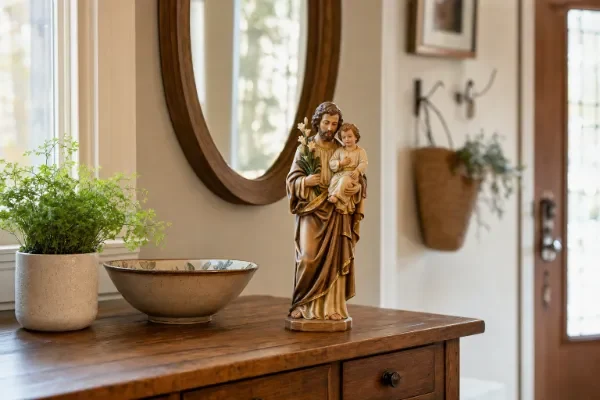
Selling a home can be one of the most stressful seasons of life. Between repairs, showings, negotiations, and the uncertainty of timing, it is little wonder that so many homeowners turn to prayer for peace of mind. For centuries, Catholics have brought exactly this kind of need to St. Joseph, the foster father of Jesus and the quiet, steady protector of the Holy Family’s home in Nazareth.
If you have searched for a “St. Joseph prayer to sell a house,” you have likely also come across the popular custom of burying a small statue of St. Joseph in the yard, sometimes upside down, as a way of asking for his help. This article explains where that custom came from, why it is not an official Catholic practice, and offers a more reverent, faithful way to seek St. Joseph’s intercession, along with an original prayer you can use today.
Why Ask for St. Joseph’s Intercession
Catholic devotion has always included asking the saints to pray for us, much as we might ask a friend or family member for prayer support. This is called intercession. Catholics do not worship saints; they ask saints, who are believed to be alive in Heaven and close to God, to join their prayers to ours, the same way we might ask a grandmother or a parish priest to “keep us in their prayers.”
St. Joseph is one of the most beloved intercessors in the Catholic tradition. He is trusted precisely because Scripture shows him as a quiet, faithful, obedient man who provided and cared for his family under real pressure and uncertainty, qualities that resonate deeply with anyone facing the stress of selling a home.
Why St. Joseph Is the Patron of Homes, Families, and Workers
The Catholic Church honors St. Joseph with several titles that make him a natural patron for home-related prayers:
- Patron of the Universal Church, entrusted with protecting the Holy Family
- Patron of workers, honored on May 1st as St. Joseph the Worker, recognizing his labor as a carpenter
- Patron of fathers and families, for his role as guardian of Jesus and husband of Mary
- Patron of a happy death, traditionally believed to have died with Jesus and Mary at his side
Because St. Joseph was responsible for providing shelter and safety for his family, including finding lodging in Bethlehem and later resettling the family in Nazareth after fleeing to Egypt, Catholics have naturally turned to him when facing housing needs of their own, including buying or selling a home.
The Biblical Foundation of Asking Saints to Pray for Us
Some readers wonder whether asking a saint for help has any basis in Scripture. Catholic teaching points to passages such as Hebrews 12:1, which describes believers who have died as a “cloud of witnesses,” and the Book of Revelation, which depicts the prayers of the saints being offered before God (Revelation 5:8). The Catechism of the Catholic Church (CCC 2683) teaches that the saints in Heaven contemplate God and “keep watch” over those still on their earthly journey, interceding for them.
Asking St. Joseph to pray for a successful home sale, then, is not a superstition but an extension of ordinary Christian prayer, asking someone close to God to pray alongside you.
The History of the St. Joseph Home-Selling Tradition
The custom of seeking St. Joseph’s help when buying or selling property has circulated in Catholic communities for generations, often passed along informally rather than through any official Church document. Over time, the tradition became closely tied to St. Joseph’s identity as the guardian of the household in Nazareth, and to popular piety surrounding household blessings.
Like many folk devotions, the practice grew largely through word of mouth, real-estate circles, and popular retellings rather than through formal catechesis, which is part of why the details, including the now-famous “bury the statue” custom, vary so widely from region to region.
Where the Burying of the Statue Came From
One popular story traces the custom to a group of nuns in medieval Europe who, according to legend, buried medals or small statues of St. Joseph on land they hoped to acquire for a convent, asking his intercession to secure the property. Over time, this story was adapted and popularized, particularly through real estate circles in the 20th century, into the modern custom of homeowners burying a St. Joseph statue, often upside down, facing the house, to “speed up” a sale.
It is important to note that this origin story cannot be verified through any official Church record. It survives as popular legend, passed down and reshaped over time, rather than as documented history.
Is Burying a St. Joseph Statue Required?
No. The Catholic Church has no official teaching, decree, or requirement that a St. Joseph statue be buried, upside down or otherwise, in order to sell a home. This is a popular folk custom, not a sacrament, a sacramental practice, or a Church-approved devotion. Many priests gently discourage the practice, not because sincere faith is ever wrong, but because treating a buried statue as the “mechanism” that produces a sale can drift toward superstition rather than genuine trust in God.
A statue, whether buried or displayed, has no power in itself. It is a sacramental reminder meant to draw the heart toward prayer, the prayer itself, offered with faith, is what matters.
Faith vs. Superstition
The Catechism of the Catholic Church addresses this distinction directly. Superstition, the Catechism teaches, is “a deviation of religious feeling and of the practices this feeling imposes” in which “one attributes an importance in some way magical to certain practices” (CCC 2111). Genuine Catholic devotion, by contrast, always points back to God and flows from trust, humility, and love, not from the idea that a particular object or ritual guarantees an outcome.
This is precisely why treating the burial of a statue as a good-luck ritual, that must be done in a specific way, oriented a specific direction, at a specific depth, or it “won’t work” can unintentionally shift the practice away from prayerful trust and toward superstition. Asking St. Joseph’s intercession is always appropriate; treating a statue’s placement as a magic formula is not.
Why Many Catholics Prefer Displaying a Blessed Statue in the Home
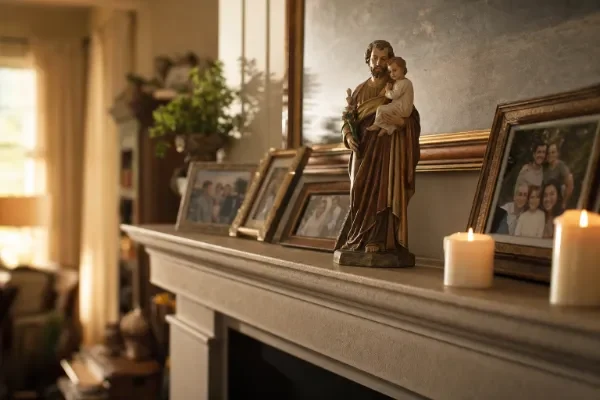
Rather than burying a statue of St. Joseph, many Catholics, and many priests, recommend a more reverent alternative: having the statue blessed by a priest and displaying it in a prominent, honored place within the home, such as an entryway, a family altar, or near the front door. This approach reflects the same posture Catholics take toward all sacred images: statues and icons are not buried or hidden away, but placed where they can serve as a visual invitation to prayer.
This practice keeps the focus where it belongs: on a relationship of trust with St. Joseph and with God, rather than on the mechanics of a ritual.
Preparing Your Home Both Spiritually and Practically
Faithful Catholics can prepare a home for sale on two levels at once:
- Spiritually: Have the St. Joseph statue blessed by a priest, place it in an honored spot in the home, and commit to praying a novena or daily prayer asking for his intercession and for God’s will to be done.
- Practically: Make the home presentable, complete necessary repairs, price it honestly, and work with people you trust throughout the process.
Prayer and preparation are not in competition with one another. A Catholic approach to selling a home embraces both: doing the practical work well while entrusting the outcome, and its timing, to God through the intercession of St. Joseph.
How to Pray for St. Joseph’s Intercession
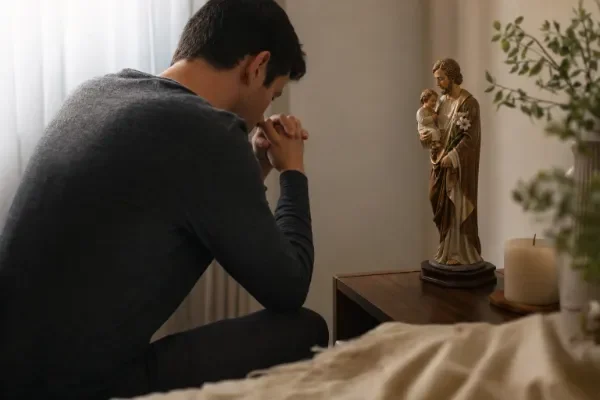
There is no single required formula for asking St. Joseph’s help. What matters most is sincerity, humility, and trust. Many Catholics choose to pray daily for nine days (a novena), display the blessed statue, and attend Mass or visit a parish dedicated to St. Joseph if one is nearby. Others simply pause each day near the statue to offer a short, heartfelt prayer.
A New Prayer to St. Joseph for Selling a Home
Dear St. Joseph, faithful guardian of the Holy Family and patron of every household, you cared for Mary and Jesus with quiet strength, trust, and unwavering obedience to God’s will. I come to you now with the burden of selling my home. Please intercede for me before the Lord, that this home may find its way, in God’s time, to the family He has prepared for it. Grant me patience in the waiting, wisdom in every decision, and peace in the uncertainty. Above all, help me to trust, as you trusted, that God’s plan is greater than my own timeline. St. Joseph, protector of homes and families, pray for us. Amen.
Additional Catholic Prayers
Alongside a personal prayer, many Catholics also incorporate traditional devotions such as the Litany of St. Joseph, the Memorare (adapted to ask St. Joseph’s intercession), or a formal novena to St. Joseph, many versions of which are available through diocesan and Catholic devotional resources.
Trusting God’s Will
It is worth remembering that the purpose of asking for St. Joseph’s intercession is not to guarantee a particular outcome on a particular timeline, but to draw closer to God and to entrust a genuine worry into His care. Sometimes a home sells quickly; sometimes it takes longer than expected, or the path forward looks different than anticipated. A mature, faithful approach to prayer holds both hope and surrender together, asking confidently, while trusting that God’s timing and provision are ultimately for our good.
Practical Home-Selling Tips
Prayer works hand in hand with sound preparation. A few practical steps can make a genuine difference alongside your spiritual devotion:
- Address visible repairs before listing, especially anything that affects safety or first impressions
- Declutter and depersonalize spaces so buyers can picture themselves living there
- Price the home honestly based on comparable local sales
- Be transparent about the home’s condition and history
- Stay flexible with showings and open communication with your agent or buyer
Common Mistakes Sellers Make
- Overpricing the home based on emotional attachment rather than market data
- Ignoring necessary repairs that later stall negotiations
- Treating prayer or ritual as a substitute for reasonable preparation
- Waiting too long to explore alternatives when a traditional sale isn’t moving
- Underestimating the stress of holding two properties or an extended timeline, especially during foreclosure, inheritance, divorce, or relocation
When Prayer and Practical Solutions Work Together
For many homeowners, prayer brings real peace, but circumstances such as foreclosure, an inherited property, a divorce, a job relocation, or a home in need of costly repairs can make a traditional listing difficult or simply not the right fit for the timeline God seems to be opening up. In these situations, it is not a lack of faith to also explore practical paths forward. Trusting St. Joseph’s intercession and making a sound, informed decision about how to sell your home are not in conflict, they can walk together.
If your situation calls for a faster, more certain path, whether due to timing, condition of the property, or personal circumstances, Templar Cash for Houses offers homeowners a straightforward, no-obligation option to sell as-is, without the uncertainty of showings, repairs, or an open-ended timeline, so you can move forward with confidence and peace of mind.
Final Encouragement
Whatever path your home sale takes, you are not walking through it alone. St. Joseph’s example, quiet trust, steady faithfulness, and care for his family through real uncertainty, offers genuine comfort to anyone navigating the stress of selling a home. Pray with confidence, prepare with diligence, and trust that God is at work even when the timeline is unclear.
Frequently Asked Questions
Is it a sin to bury a St. Joseph statue?
No official Church teaching calls the practice sinful, but many priests discourage it because it can drift toward superstition. A more reverent alternative is to display a blessed statue in a place of honor in the home.
Should a St. Joseph statue be buried upside down?
This is a popular custom, not a Catholic teaching or requirement. There is no theological basis for burying the statue in any orientation, and displaying it upright in the home is the more traditionally reverent practice.
Does the St. Joseph prayer to sell a house actually work?
Catholics believe prayer and intercession are always heard by God, though the outcome and timing are left to His will. Many families report peace of mind and a sense of trust through the process, regardless of how quickly the home sells.
Where did the tradition of burying St. Joseph statues come from?
Popular legend traces it to a story about nuns burying statues or medals to acquire land for a convent. The origin cannot be verified through Church records and is best understood as folk tradition rather than documented history.
How should I display a St. Joseph statue in my home?
Have the statue blessed by a priest and place it in a visible, honored location, such as an entryway, mantel, or family prayer space, as a reminder to pray for his intercession.
What prayer should I say to St. Joseph when selling my house?
Any sincere, heartfelt prayer is appropriate. This article includes an original prayer you can use, along with suggestions for traditional Catholic devotions such as a novena to St. Joseph.
Is St. Joseph the patron saint of selling a house?
St. Joseph is formally recognized as patron of the universal Church, workers, fathers, and families. His association with home sales grew from popular devotion tied to his role as guardian of the household, rather than from a formal Church title specific to real estate.
Can I ask St. Joseph for help even if my home sale is complicated (foreclosure, inheritance, divorce)?
Yes. St. Joseph’s intercession can be sought in any circumstance. Many homeowners combine prayer with practical guidance, including exploring options such as a direct home sale, when facing complex situations.
Do I need a specific novena to pray to St. Joseph?
No specific novena is required. Traditional novenas to St. Joseph are widely available through Catholic resources and can be a meaningful structure for nine days of focused prayer, but a simple daily prayer is equally valid.
What does the Catholic Church actually teach about asking saints for help?
The Church teaches that saints in Heaven intercede for those on earth, and that the faithful may ask for their prayers, much as one might ask a friend to pray for them (CCC 2683). This is distinct from worship, which is reserved for God alone.
Ready to Talk to a Local NJ Cash Buyer?

Understanding who cash buyers are is in the first step. The second is finding out whether selling to one actually makes sense for your specific situation in New Jersey.
Every homeowner’s circumstances are different. If you’re dealing with a property that needs work, a timeline that doesn’t fit the traditional listing process, or a situation where certainty matters more than squeezing out the last dollar, a direct conversation costs you nothing and can answer a lot of questions quickly.
Call Templar Cash for Houses at 973-240-8593 or visit templarcashforhouses.com. We’ll walk you through what we’d offer and why, with no pressure and no obligation to move forward.